
Dauphin County Probate Court Records in Harrisburg
Dauphin County probate court records are maintained by the Register of Wills and the Clerk of Orphans' Court at the courthouse in Harrisburg, Pennsylvania. The county has kept probate records since 1795, the year it was established, and estate documents from the late 1700s onward remain accessible today. Harrisburg is also the state capital, so the offices here handle a high volume of filings. Researchers can search probate records online through the county's public search portal or visit the courthouse in person during business hours. Both options provide access to wills, estate inventories, letters, and Orphans' Court filings.
Dauphin County Quick Facts
Dauphin County Probate Records Overview
Dauphin County was created from Lancaster County on March 4, 1785, and the Register of Wills began keeping probate records when the county was organized in 1795. The courthouse is located at 101 Market Street, Harrisburg, PA 17101. The Register of Wills is on the 2nd Floor. The Register of Wills phone is 717-780-6500, and the Clerk of Orphans' Court phone is 717-780-6510. Both offices serve the public during regular business hours.
Dauphin County's probate record collection spans more than two centuries. Estate records from the late 1700s document property transfers and family relationships in early Harrisburg and the surrounding region. Inheritance tax dockets begin in 1917 and run continuously to the present. Marriage records start in 1885, and birth and death records from 1893 to 1906 are also held by this office. Researchers tracing genealogical lines will find this combination of records especially productive.
The probate record types held by this office include wills, codicils, letters testamentary, letters of administration, estate inventories, accountings, and Orphans' Court filings. Each type of document serves a specific purpose in the estate administration process. Wills name the testator's wishes. Inventories list all property. Accountings show how the executor handled estate funds. Together these documents form a detailed record of each estate opened in Dauphin County since 1795.
Online Search for Dauphin County Probate Filings
The Dauphin County Public Search portal allows anyone to search probate and Orphans' Court records online. Registration is free. Once registered, you can search by name, case number, or date range to find estate records. The system covers a broad range of case types including probate estates, small estates, guardianships, and other Orphans' Court matters.
Document downloads through the portal cost $0.50 per page with a $2.00 surcharge per transaction. If you plan to download many documents, a monthly subscription at $25 per month allows free printing and is more cost effective for heavy research. The subscription covers unlimited downloads for the month, making it a good option for genealogists or attorneys working on multiple estates.
The image below comes from the Dauphin County Public Search portal, showing the online interface for searching probate court records in Harrisburg.
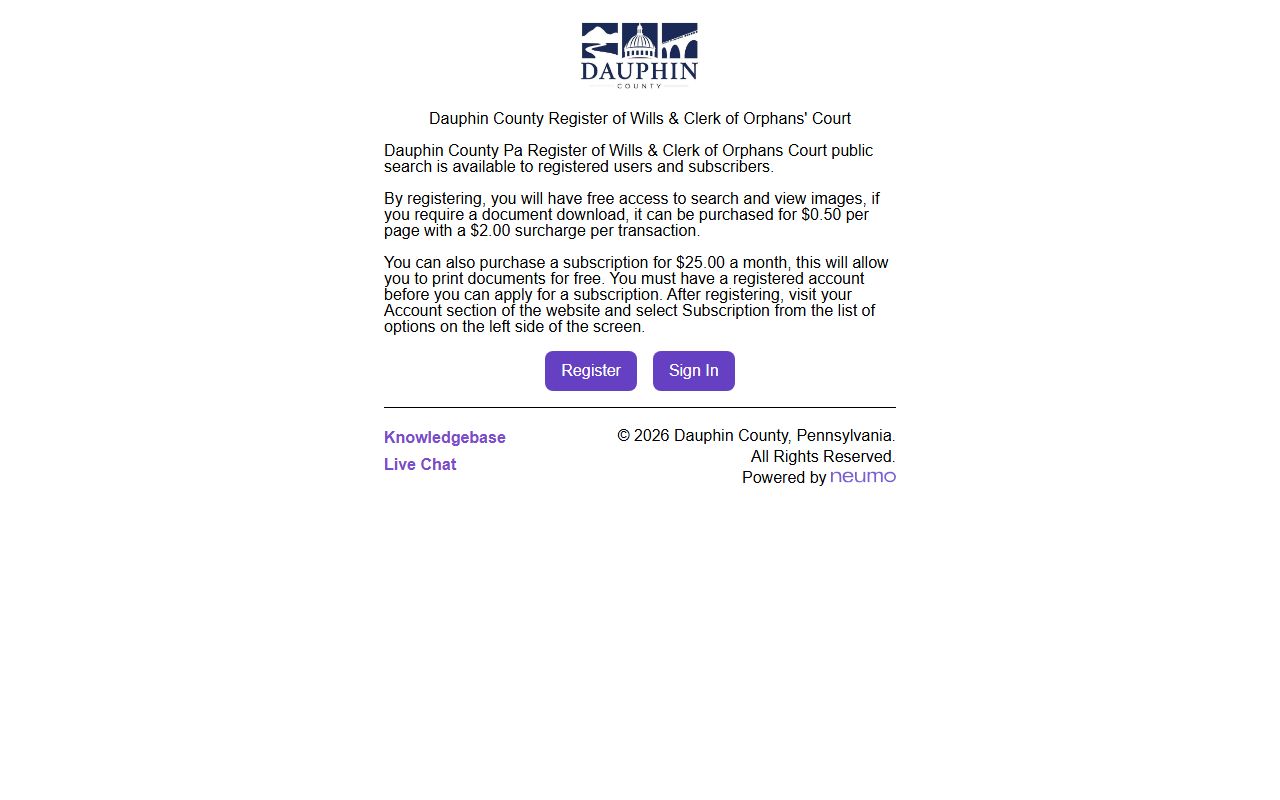
The portal provides free registration and covers estate records from the Register of Wills and Orphans' Court filings for Dauphin County.
Note: The online portal is best for records from recent decades; very old estate files from the late 1700s may only be available through an in-person visit to the courthouse at 101 Market Street.
Understanding Dauphin County Probate Court Procedures
Opening a probate estate in Dauphin County follows the standard Pennsylvania process. The petitioner presents the original will, a certified death certificate, a completed estate information sheet, and the required filing fee. The Register reviews the will for proper execution, meaning it was signed by the testator before witnesses as required by law. Once satisfied, the Register issues Letters Testamentary to the named executor. When no will exists, the Register issues Letters of Administration to the next of kin or another qualified person.
After letters are issued, the executor or administrator has duties to fulfill. These include inventorying all estate assets, notifying known creditors, paying valid debts, filing the Pennsylvania inheritance tax return on form REV-1500, and eventually presenting a formal accounting to the court. The accounting lists all money received into the estate and all disbursements made. Beneficiaries may object to an accounting if they believe funds were mishandled. The court reviews any objections and enters a final decree approving the accounting and directing distribution.
Pennsylvania law gives executors and administrators broad powers to manage estate property during the administration period. Real estate may be sold to pay debts or divided among heirs. Bank accounts are marshaled and used to pay expenses. Securities may be sold or transferred. The executor has a fiduciary duty to act in the best interest of all beneficiaries throughout this process.
Dauphin County Orphans' Court and Contested Probate Matters
The Orphans' Court Division in Dauphin County handles cases that go beyond routine estate administration. Will contests, disputed accountings, guardianship petitions, adoption proceedings, and trust matters all fall within the court's jurisdiction. Harrisburg's position as the state capital means the Dauphin County Orphans' Court handles a significant caseload that reflects the county's large and diverse population.
Will contests are among the most common contested matters. A person challenging a will must typically claim that the testator lacked testamentary capacity, was subject to undue influence, or that the will was not properly executed. The burden of proof rests with the challenger. Evidence may include testimony from witnesses, medical records, and statements from people who knew the testator. The Register first hears some disputes as a quasi-judicial officer before they proceed to the Orphans' Court judge.
Guardianship cases arise when a person can no longer manage their own financial affairs or personal care decisions. A family member or other interested party petitions the court, and the court appoints a guardian after reviewing the evidence. Guardians must file annual reports with the court showing how the ward's assets are being managed. These records are public and can be found through the Orphans' Court docket.
Inheritance Tax and Pennsylvania Revenue in Dauphin County
Because Harrisburg is the Pennsylvania state capital, the state's taxing authority and the local probate office work in close coordination. The Dauphin County Register of Wills acts as the Commonwealth's agent for collection of Pennsylvania inheritance tax. Executors file the REV-1500 inheritance tax return with the Register, who processes it and forwards payment to the Pennsylvania Department of Revenue.
The inheritance tax rate depends on the relationship between the decedent and the beneficiary. Surviving spouses pay 0%. Lineal descendants and ancestors pay 4.5%. Siblings pay 12%. All other heirs pay 15%. Charities and exempt organizations are generally not subject to the tax. A 5% discount is available if the full tax is paid within three months of the date of death, which is a meaningful savings on larger estates.
Note: Dauphin County's proximity to state government offices means residents can often address both county probate filings and state inheritance tax inquiries in the same trip to Harrisburg.
Genealogical Research Using Dauphin County Probate Records
Dauphin County probate records are a strong resource for anyone researching central Pennsylvania families. Estate records from the late 1700s describe property, name heirs, and list executors in enough detail to establish family relationships across multiple generations. The combination of probate records, marriage records from 1885, and birth and death records from 1893 to 1906 provides a broad documentary base for genealogical work.
The Pennsylvania Historical and Museum Commission has digitized many early records and made them searchable online. Cross-referencing those materials with Dauphin County's own records often reveals details that neither source alone provides. Researchers working on families that moved between Lancaster County and Dauphin County should check both repositories, since Lancaster County records predate Dauphin County's formation in 1785.
Nearby Counties
Dauphin County borders several south-central Pennsylvania counties, and estates for residents near county lines may be filed in a neighboring Register of Wills office.